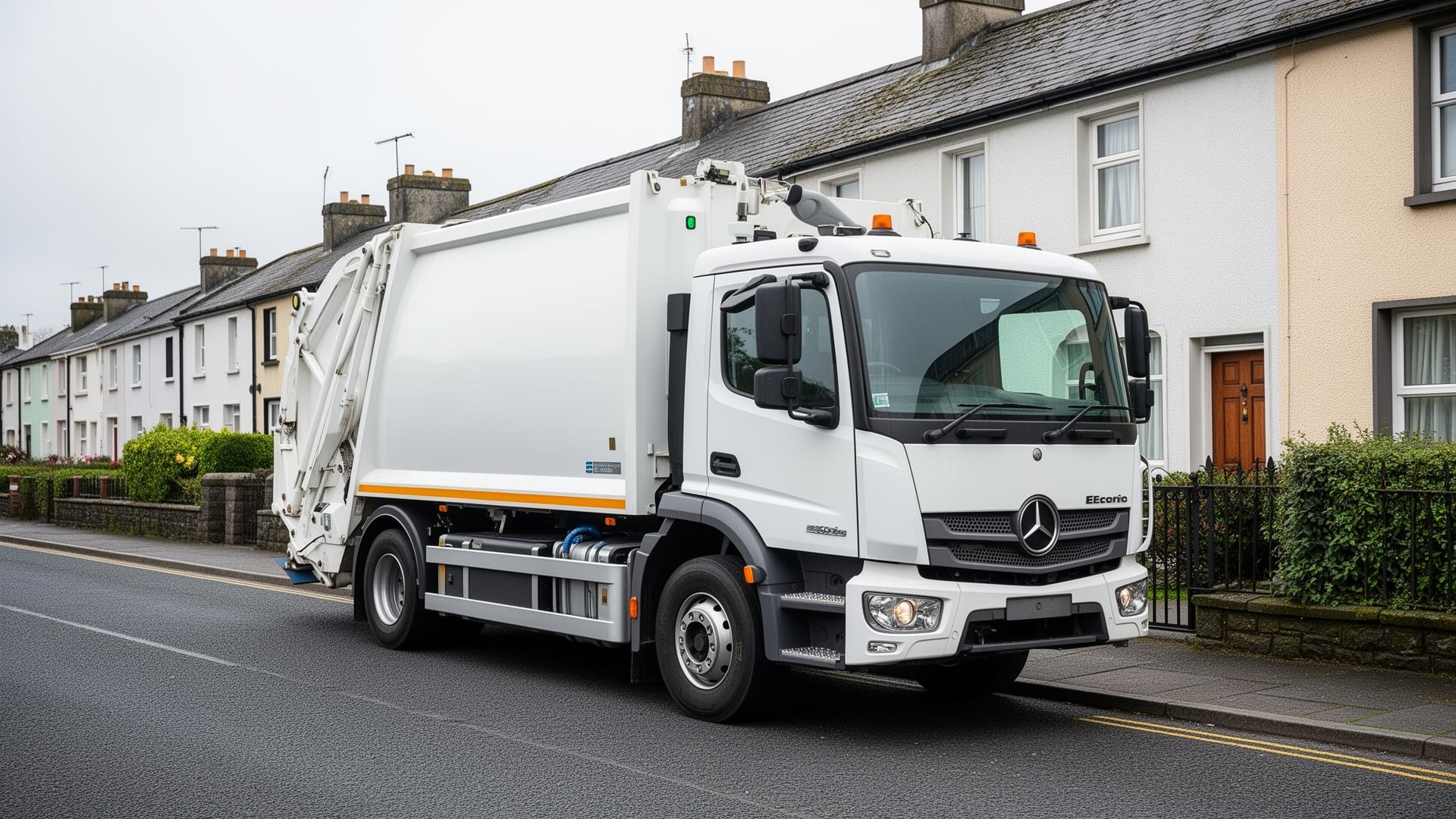
Mercedes-Benz's purpose-built electric refuse truck — the eEconic features a low-entry cab for driver safety, 396kWh battery and 200km daily operational range ideal for Irish councils and waste management operators.
🔍 Tap to enlarge
€355,278
After SEAI grant
200km WLTP
~154km real-world
200WLTP range km396kWh battery
154Real range kmIrish conditions est.
160Max DC kWFast charging
19.0s0–100 km/hAcceleration
€355,278Net priceAfter grants
€900Motor tax/yr27t GVW rate
⚙️ Technical specifications
Battery capacity
396 kWh
WLTP range
200 km
Real-world range (Ireland)
~154 km
Acceleration (0–100 km/h)
19.0s
Top speed
89 km/h
Torque
2,800 Nm
Drivetrain
RWD
Max DC charge rate
160 kW
Max AC charge rate
22 kW
Connectors
CCS · Type 2
Gross vehicle weight
27 t
Seats
3
Dimensions
Length
8,500 mm
Width
2,550 mm
Height
3,500 mm
Battery warranty
8 years / 800,000 km
CO₂ emissions
0 g/km
🏁 WLTP range200km
🇮🇪 Real-world (Irish)~154km
Estimates based on mixed Irish motorway/urban driving. Actual range varies with speed, temperature, load and driving style.
Mercedes-Benz highlights
🌐
Mercedes me Charge
Single account for 1M+ chargers globally — ESB, Ionity and more
🔇
EV-specific refinement
Active noise cancellation and aero-optimised body for cabin silence
💰 Irish pricing & incentives
List price (inc. 23% VAT)€380,000
ZEHDV Grant (Dept. of Transport, administered by TII) (Medium enterprise, est.)− €24,722
Net price after grants€355,278
ZEHDV grant by enterprise size (% of the €49,443 price differential vs. the TII baseline diesel truck, €259,500 ex VAT):
Enterprise size
Rate
Estimated grant
Small
60%
€29,666
Medium
50%
€24,722
Large
30%
€14,833
Enterprise size follows the EU SME definition (staff headcount plus turnover or balance sheet). Total ZEHDV support is capped at €500,000 per undertaking (including affiliates) per budgetary year. See the full ZEHDV grant guide for eligibility details.
💡 Total savings of €24,722 shown at the Medium-enterprise rate — see the table above for your enterprise size. Always verify eligibility at seai.ie.
ZEHDV Grant (Dept. of Transport, administered by TII) €24,722Motor tax €900/yr
Estimated annual running costs (100,000km)
Home/depot charging (€0.24/kWh)
~€47,520
Public charging (€0.49/kWh avg)
~€97,020
Motor tax
€900/yr
Saving vs diesel equivalent (€1.65/L)
~€1,980/yr
💡 Fuel savings:
At €0.24/kWh depot charging rate vs diesel at €1.65/L, annual fuel savings on the eEconic at 100,000km are typically ~€1,980, based on the estimate above — actual savings vary with route profile and driving conditions.
🇮🇪 eEconic on Irish routes
Haulage route analysis for typical Irish distribution and logistics operations.
🚛 Dublin Port → Cork depot260km · M8
⚡ Charge stop recommended
🛤️ Dublin Port → Galway depot220km · M6
⚡ Charge stop recommended
✈️ Dublin → Shannon Freeport195km · M7/N18
⚡ Charge stop recommended
🔄 Regional depot return300km · Round trip
⚡ One rapid charge stop needed
🌙 Night linehaul Dublin–Cork260km · M8 single
⚡ Charge stop recommended
🏙️ Daily urban distribution100km · /day
✅ Comfortably within daily range
Based on ~154km estimated real-world range. Actual range varies with load, speed and conditions.
👥 Is the eEconic right for you?
Daily route (<139km)
✅ Single charge
Long haul (>154km)
⚠️ Rapid charge stop needed
ZEHDV grant eligible
✅ €24,722 at Medium-enterprise rate (50%)
Max payload
✅ See spec sheet
GVW class
✅ 27t GVW
Depot charging (overnight)
✅ 160kW DC recommended
Fleet telematics integration
✅ Available
Motor tax
€900/yr (27t GVW band)
💡 Best for: Municipal refuse and street cleaning.
⚡ Charging guide
🏠 7.4kW home wallbox (0–100%)
~54h
🏠 11kW three-phase (0–100%)
~36h
🏢 22kW AC (0–100%)
~18h
⚡ 50kW ESB ecars DC (10–80%)
~333min
🚀 160kW DC ultra-fast (10–80%)
~104min
Connectors (DC)
CCS
Connectors (AC)
Type 2
🔌 Irish networks: Compatible with ESB ecars, Ionity, EZO, Circle K and Applegreen via CCS. Mercedes me Charge provides access to 1,000,000+ chargers globally via a single account.
Mercedes me Charge gives EQ owners a single account for 1,000,000+ public chargers across Europe, including all major Irish networks.
📐 Dimensions & cargo
Length
8,500 mm
Width
2,550 mm
Height
3,500 mm
Towing
Not rated
GVW
27 tonnes
Seats
3
Battery warranty
8 years / 800,000 km
🔋 Battery warranty: 8 years / 800,000 km. Manufacturer covers against capacity loss below 70%.
The Mercedes-Benz eEconic Refuse Truck has an Irish list price of €380,000 (including 23% VAT). After the ZEHDV Grant (Dept. of Transport, administered by TII) of €24,722, the net cost is approximately €355,278. Confirm current pricing with your authorised dealer and verify grant eligibility at seai.ie.
The Mercedes-Benz eEconic Refuse Truck has a WLTP official range of 200km. In real-world Irish conditions — stop-start delivery routes, cold mornings and motorway runs with payload — expect approximately 154km per charge. This suits depot-based daily operations comfortably.
The ZEHDV grant is not a flat figure — it is calculated as a percentage of the price differential between the Mercedes-Benz eEconic Refuse Truck and the equivalent diesel truck (TII baseline: €259,500 ex VAT). For this vehicle, that works out to approximately €29,666 for a small enterprise (60%), €24,722 for a medium enterprise (50%), or €14,833 for a large enterprise (30%) of the €49,443 price differential. The ZEHDV scheme is administered by Transport Infrastructure Ireland (TII) on behalf of the Department of Transport — not SEAI. Applications go to: zehdvgrant@pierse.ie. Total ZEHDV support is capped at €500,000 per undertaking (including affiliates) per budgetary year. The vehicle must be new and zero-emission. See our full ZEHDV grant guide for enterprise-size definitions and how the cap works, and contact TII/Pierse Fitzgibbon directly to confirm your figure before ordering.
The Mercedes-Benz eEconic Refuse Truck has a maximum payload of see specification sheet at a GVW of 27 tonnes. Note that electric trucks carry a slightly heavier kerb weight than diesel equivalents due to battery mass — always verify the specific variant's VIN plate payload figure. The WLTP range of 200km is tested at 80% of maximum payload.
The Mercedes-Benz eEconic Refuse Truck has a WLTP official range of 200km, measured at 80% payload under standardised test conditions. Under real-world Irish conditions — full payload, motorway speeds, varying weather — expect approximately 154km per charge. For route planning, use 123km as a conservative daily operational figure, leaving a 20% buffer. For long-haul routes beyond this, plan a midday rapid charge stop — the Mercedes-Benz eEconic Refuse Truck supports up to 160kW DC, adding approximately 100km of range in 22 minutes.
At 100,000km per year: depot charging at €0.24/kWh costs approximately €47,520 in electricity — compared to approximately €49,500 in diesel at €1.65/L for an equivalent truck. Annual fuel saving: approximately €1,980. Add maintenance savings — no diesel particulate filter, no AdBlue, no oil services, fewer brake replacements — typically €3,000–€6,000/year. Most fleet operators reach total cost of ownership parity within 3–4 years once the ZEHDV grant is factored in — see the pricing section above for this vehicle's specific grant range by enterprise size.
The Mercedes-Benz eEconic Refuse Truck supports up to 160kW DC and 22kW AC. For overnight depot charging, a 22kW three-phase AC wallbox delivers a full charge in approximately 18 hours — ideal for vehicles returning to base each night. For faster turnaround, a 150kW+ DC charger charges 10–80% in approximately 111 minutes. ESB ecars Business and EasyGo Fleet both provide commercial depot charging solutions in Ireland. SEAI's EV Infrastructure grant can cover up to 75% of installation costs for commercial depots — apply before installation begins.
As a zero-emission vehicle, the Mercedes-Benz eEconic Refuse Truck produces no tailpipe CO₂ or NOx — it will not be subject to restrictions in any planned Irish Low Emission Zone. Dublin City Council and Cork City Council are both advancing LEZ plans targeting diesel vehicles in city centre and port areas. The Mercedes-Benz eEconic Refuse Truck will have unrestricted access to these zones when implemented. For operators currently running diesel trucks on inner-city routes, transitioning to zero-emission vehicles like the Mercedes-Benz eEconic Refuse Truck now — supported by the ZEHDV grant — positions your fleet ahead of compliance requirements.
The Mercedes-Benz eEconic Refuse Truck supports up to 160kW DC and 22kW AC charging. At a 7.4kW home wallbox, a full charge takes approximately 54 hours. At a 50kW ESB ecars rapid charger, 10–80% takes around 333 minutes. At the maximum 160kW DC rate, 10–80% takes approximately 104 minutes.
The Mercedes-Benz eEconic Refuse Truck uses CCS (DC fast charging) and Type 2 (AC), compatible with all major Irish networks including ESB ecars, Ionity, EZO, Circle K and Applegreen.
Motor tax for the Mercedes-Benz eEconic Refuse Truck is €900 per year — the rate for a zero-emission heavy goods vehicle (HGV) in the 27t GVW class. Commercial vehicle motor tax in Ireland is determined by gross vehicle weight (GVW), not CO₂ emissions. You can verify the exact band for your vehicle at motortax.ie.
🔍 Also consider
Same category · similar real-world range · ranked by price.
Interested in the Mercedes-Benz eEconic?
Use our free calculators to estimate your fleet running costs, grant savings and total cost of ownership.
🔗 Everything you need alongside the Mercedes-Benz eEconic Refuse Truck
Heavy vehicles like the Mercedes-Benz eEconic Refuse Truck require DC rapid charging for practical overnight depot turnaround. A 150kW+ DC charger delivers a full charge in a commercially viable timeframe:
☀️Solar panels for your depot or yard — offset charging costs
Solar panels on a depot, warehouse or yard building can offset a significant portion of EV charging costs — reducing grid import and improving fleet TCO. SEAI Non-Domestic Microgen grants and TAMS III (agri) are available. Accelerated Capital Allowance allows year-1 tax write-off.
ZEHDV Grant guide — how to apply for the truck grant
The Zero Emission Heavy Duty Vehicle (ZEHDV) grant is NOT administered by SEAI — applications go to the Department of Transport. Our guide covers eligibility, documentation, how to apply for multiple vehicles in one submission, and common mistakes to avoid.
📲 Park & Charge: manage EV charging with De Energy Hub
Search for EV charging by location, book a session in advance or scan the QR code on arrival, then check in via the app. Get De Energy Hub free on the App Store or Google Play.
📲 Get De Energy Hub app
Download De Energy Hub to manage EV charging bookings across your sites, or list your own chargers as bookable Hubs.
Free to download. Search, book and check in, all from your phone.
De Energy Hub
More power to you®.
🏭 Built for depots, warehouses & logistics operators
Open your depot to partner fleets — managed EV charging
Truck, van, bus and minibus depots can now open their charging infrastructure to visiting partners and contract fleets. Set your energy rate — charge from your solar at Pure Energy rates, blend with grid on Smart Energy, or run at full grid speed on Boost Energy. Filter bookings by vehicle category — Car, Van, Truck, Bus, Minibus, Campervan — so the right charger is always assigned.
☀️ Pure Energy🔄 Smart Energy🚀 Boost Energy
🚛
Filter by vehicle category
Cars, vans, trucks, buses and minibuses each routed to the right charger type — no mismatches
🔗
Partner depot access
Open your depot to visiting partners with managed booking — track every session
📊
kWh & session tracking
Live energy usage, cost per session and cumulative depot totals — all in one dashboard